Pearson Edexcel · GCSE · Mathematics
Course version: 1MA1 · Version from Mar 2026
Number - Structure and calculation: order positive and negative integers, decimals and fractions; use the symbols =, ≠, <, >, ≤, ≥
Why is −9 smaller than −2, but 0.4 greater than 0.38? Master number-line position, place value and fraction equivalence to order mixed numbers confidently and use all six comparison symbols accurately in Pearson Edexcel GCSE Mathematics.
- 11 min read
- 3 worked examples
- 7 practice questions
- 15 key terms
Try the lesson
The start of the Number - Structure and calculation: order positive and negative integers, decimals and fractions; use the symbols =, ≠, <, >, ≤, ≥ lesson, made from checked teaching notes for this specification point.
Have a go first
Which symbol correctly completes the statement −7 □ −2?
There is more to this lesson
The full lesson goes on to check your understanding and help you earn the marks. Create a free account to carry on, with your progress saved.
7 days Premium · Then the free plan continues · No card, no charge
Check what you remember
Read the wording for your board, then hide it and explain integer in your own words. Rough notes are fine. This is a self-check, with no mark or grade.
Reference: Pearson Edexcel
A whole number, positive, negative or zero; it has no fractional part.
Study Notes
Overview
Ordering tells you where a number belongs relative to other numbers. In N1, you must order positive and negative integers, decimals and fractions, then use =, ≠, <, >, ≤ and ≥ accurately. This is more than a symbol-recognition skill: candidates need to see that moving right on a number line means values increase, so −9 is smaller than −2, while place value explains why 0.4 is greater than 0.38. It supports percentage and fraction work, inequality regions, probability scales and statistical ordering. Pearson Edexcel assesses N1 on both Foundation and Higher tiers in GCSE Mathematics (1MA1) 1. Typical questions ask you to write a list in ascending or descending order, insert a suitable relation, plot values on a scaled number line, or compare a fraction with a decimal. Simple published ordering items can be worth only one mark, and a published mixed comparison can be two marks 2. Therefore, read the command word, make the comparison visible, and do not assume that conversion working always earns a separate mark 3.
Key Concepts
Number-line order and negative values
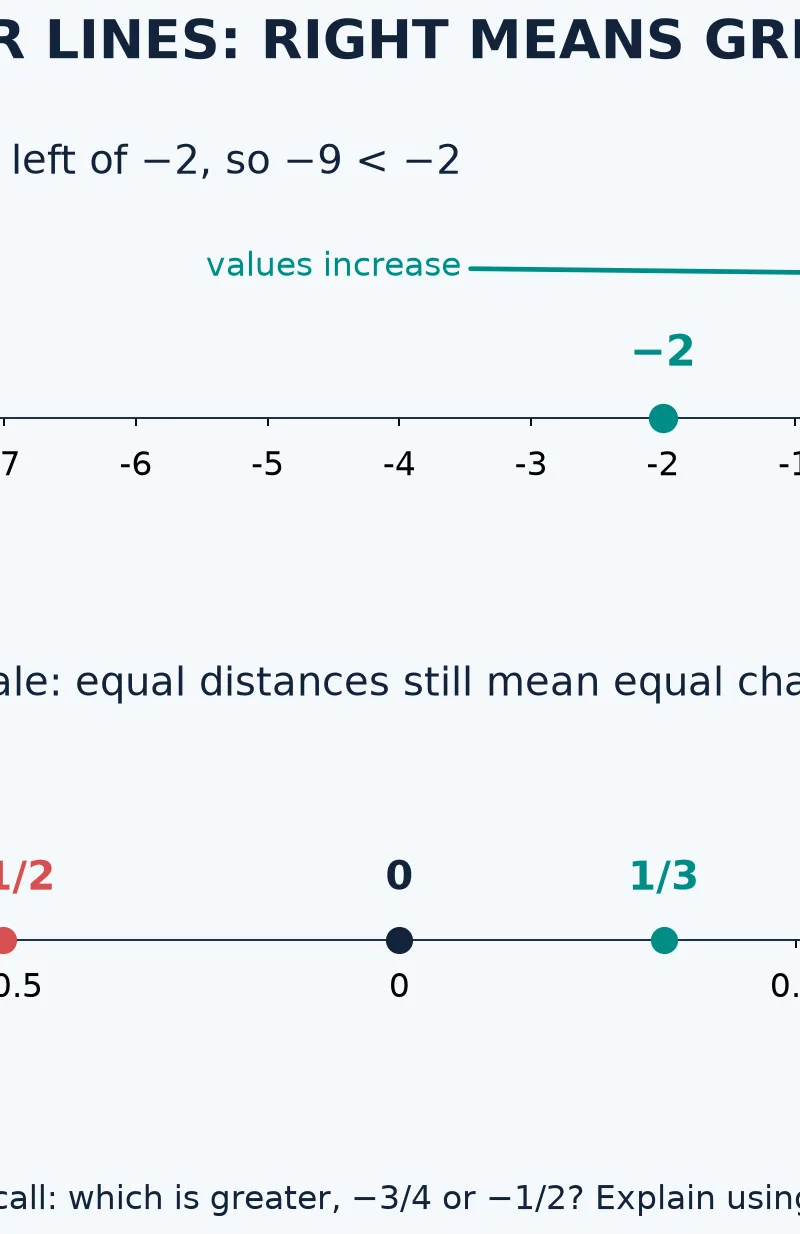
A number line is a line with equally spaced values. A value farther right is greater; a value farther left is smaller. Zero separates positive and negative values. Negatives can feel backwards because −8 is farther from zero than −3, but −8 is farther left, so −8 < −3. For a scale, inspect labelled intervals first. If 0 to 1 is divided into four equal spaces, each space is 1/4 = 0.25, not one whole unit. Plotting means putting the point at its value, not merely near the printed decimal.
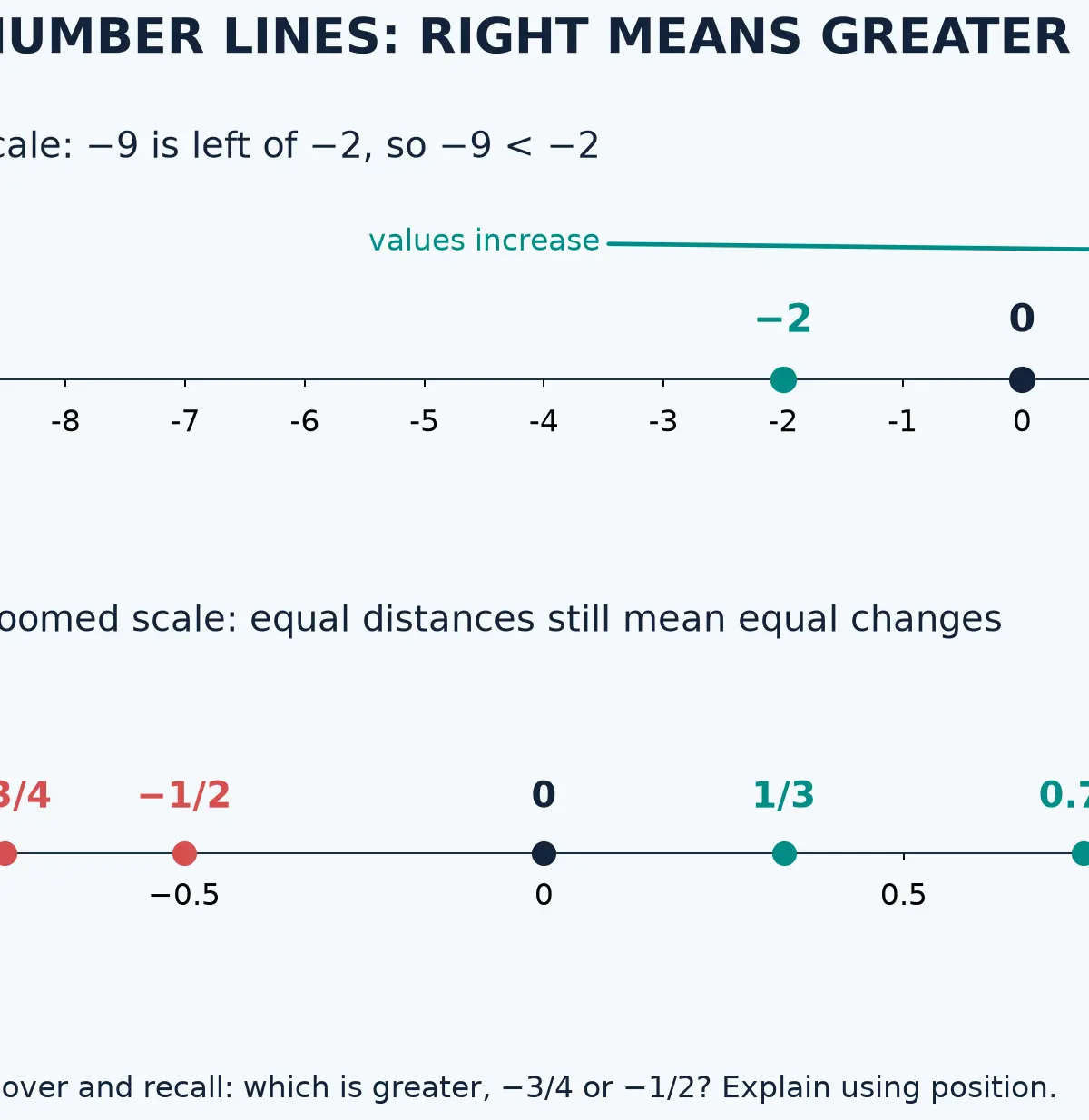
The top line in the diagram illustrates −9 < −2 < 0; the lower, magnified line lets you locate −3/4, −1/2, 0, 1/3 and 0.75 between −1 and 1. Memory check: first name the value of one small interval, then count intervals from a labelled value. A zoomed line changes the scale, not the ordering rule.
Decimal place value
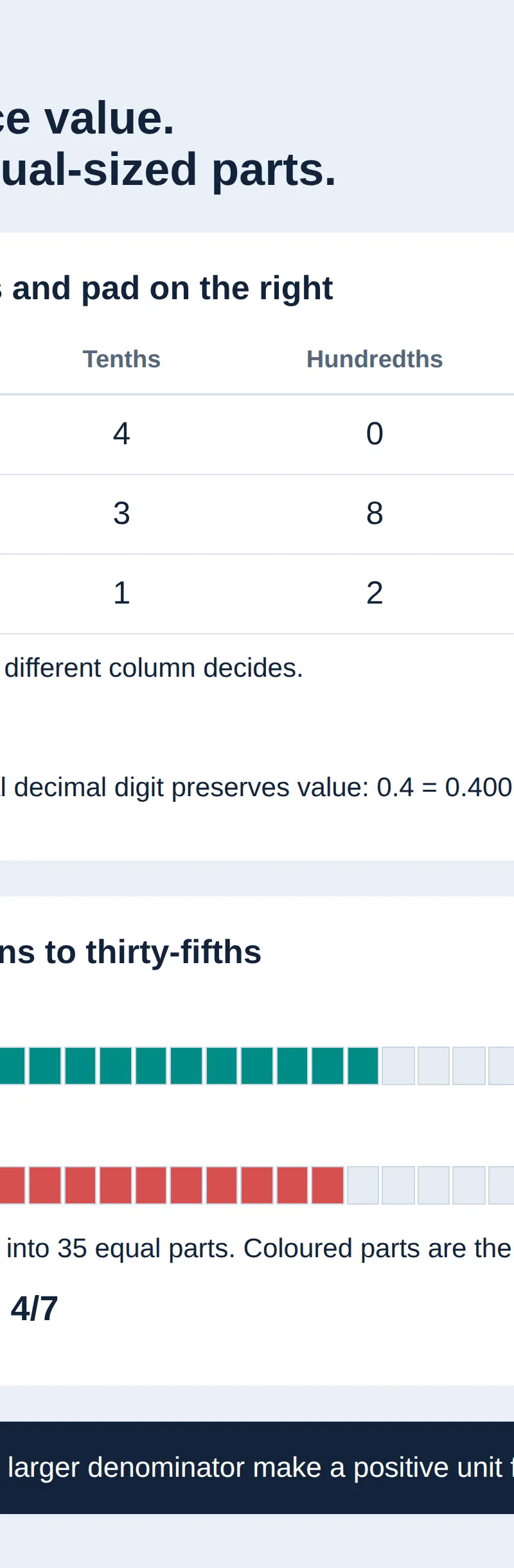
Line up decimal points and compare from left to right. Add trailing zeroes only to make the place values easier to see: 0.4 = 0.400, 0.38 = 0.380, so 0.400 > 0.380. The number of digits is irrelevant: 0.125 has three decimal places but is less than 0.4. A terminating decimal ends, such as 0.375; it can be written as a fraction over a power of ten.
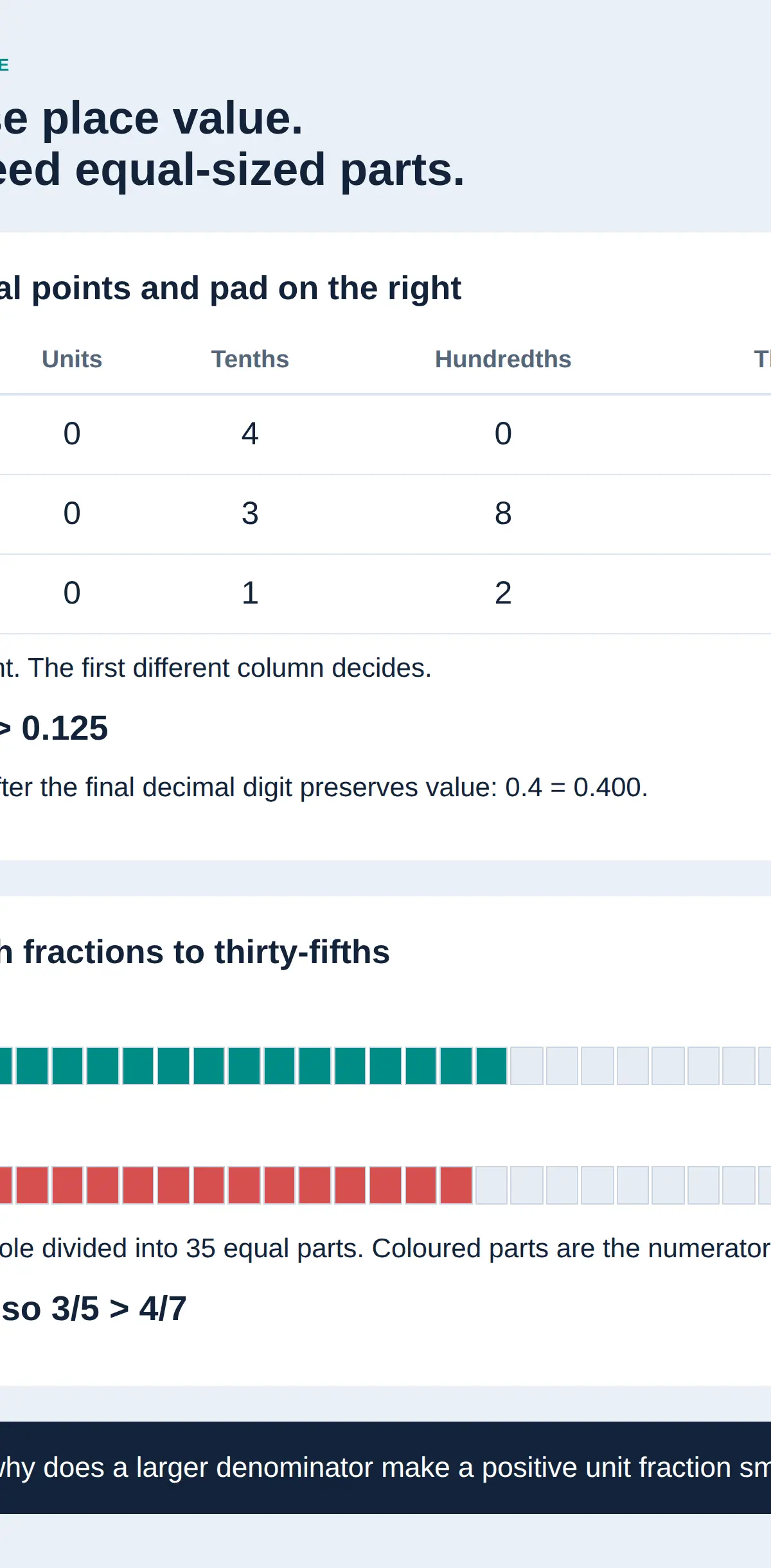
The decimal panel shows 0.400 > 0.380 > 0.125. Say the place values if asked to explain: four tenths is greater than three tenths. This is stronger than saying that one decimal “looks bigger”.
Fractions and one common form
A fraction names equal parts of a whole. Its numerator is the number of selected parts and its denominator is the number of equal parts in the whole. Compare fractions by converting them to equivalent fractions with a common denominator, or convert all values in a mixed list to decimals. For example, 3/5 = 21/35 and 4/7 = 20/35, so 3/5 > 4/7. A larger denominator alone does not make a fraction larger: with numerator 1, more equal parts means smaller parts, hence 1/8 < 1/3.
Keep originals in the final list unless the question requests converted values. Write conversions beside, rather than over, the supplied numbers. This prevents an accurate comparison turning into an answer that does not match what was asked.
The six relation symbols, precisely
| Symbol | Read as | Meaning for fixed values | Example |
|---|---|---|---|
= | is equal to | both values have exactly the same value | 0.4 = 2/5 |
≠ | is not equal to | the values differ | −2 ≠ 2 |
< | is less than | left value is strictly smaller | −3 < −1 |
> | is greater than | left value is strictly larger | 0.75 > 1/3 |
≤ | is less than or equal to | left value is smaller or equal | x ≤ 5 includes 5 |
≥ | is greater than or equal to | left value is greater or equal | t ≥ −2 includes −2 |
< and > are strict inequalities, so equality is excluded. ≤ and ≥ are non-strict, or inclusive, inequalities: their endpoints are retained. Nuance matters. If two fixed values are unequal, for example 2 and 5, both 2 < 5 and 2 ≤ 5 are true. If a question permits several symbols, acknowledge every permitted true relation; do not call ≤ false just because < is more precise. If exactly one relation is sought from a given set, follow that instruction and normally choose the most precise available symbol. When values are equal, = is the clearest exact comparison if available, while ≤ and ≥ are also true. ≠ simply states non-equality; it does not say which value is bigger.
Ordering method and direction
Ascending order means smallest to largest. Descending order means largest to smallest. Underline the requested direction before comparing. For a mixed list: (1) identify negatives, zero and positives; (2) convert difficult values to one form; (3) sort from a left-to-right number-line view; (4) write the original forms in the required direction; and (5) check adjacent pairs with a relation sign. For −3/4, −0.5, 1/3, 0.75, decimals are −0.75, −0.5, 0.333..., 0.75, giving −3/4 < −0.5 < 1/3 < 0.75.
mermaid
flowchart TD
A["Read the command and direction"] --> B["Convert awkward values to one form"]
B --> C["Locate negatives, zero and positives"]
C --> D["Order from left to right on a number line"]
D --> E["Write original forms and check adjacent pairs"]
Mathematical Relationships
Must memorise: direction relationship. On a correctly scaled number line, if a lies left of b, then a < b; if it lies right, then a > b. The equal position gives a = b. This is a relationship, not a formula-sheet item.
Must memorise: decimal equivalence. Appending or removing terminal zeroes after a decimal point preserves value: 0.4 = 0.40 = 0.400. This lets you compare equal place-value columns. No formula sheet is needed.
Must memorise: equivalent-fraction relationship. Multiplying or dividing numerator and denominator by the same non-zero integer preserves a fraction: a/b = (a×k)/(b×k), where b and k are non-zero. Use it to make a common denominator. No formula sheet is needed.
Must memorise: comparison of equal denominators. For positive fractions with the same positive denominator, the larger numerator gives the larger fraction: a/d < c/d when a < c. No formula sheet is needed.
Must memorise: fraction-to-decimal conversion. a/b = a ÷ b, with b ≠ 0. Divide numerator by denominator. If the decimal recurs, retain enough digits to distinguish the values or use exact fractions instead: 1/3 > 0.33. Do not replace a recurring value by a rounded one in an exact equality.
Must memorise: terminating-decimal conversion. A decimal with n decimal places equals its integer digits over 10^n, before simplification. For example, 0.375 = 375/1000 = 3/8. Here n = 3; the denominator records thousandths.
Must memorise: reversing signs reverses order. If a < b, then −a > −b. For example, 2 < 9 but −2 > −9, because their positions are reflected across zero. This is a relationship, not a supplied formula.
Equal values can appear in a list in different forms: 1/2 = 0.5. Keep both entries if both were supplied. They can occupy either order within their tie, but do not connect them with a strict < or > sign.
Must memorise: inclusive endpoint relationship. x ≤ a includes x = a, and x ≥ a includes x = a; strict symbols exclude equality. No formula sheet is needed.
mermaid
flowchart TD
A["Are the values already comparable?"] --> B{"Are fractions involved?"}
B -->|"Yes"| C["Use a common denominator or decimals"]
B -->|"No"| D["Align decimal places"]
C --> E["Choose a true relation"]
D --> E
E --> F{"Is equality allowed by the condition?"}
F -->|"Yes"| G["Use an inclusive symbol when appropriate"]
F -->|"No"| H["Use a strict symbol when values differ"]
Practical Applications
Ordering is used whenever a boundary or ranking matters. A weather display of −2.5°C, −0.75°C and 1.2°C is ordered left to right by temperature, not by ignoring signs. In money, compare like units first: £1 = 100p, so £0.75 = 75p and is less than £1.20 = 120p. For lengths, 1 m = 100 cm and 1 cm = 10 mm; for mass, 1 kg = 1000 g; for capacity, 1 L = 1000 mL. Convert to the same unit before ordering, just as you convert fractions and decimals to a common form. Units are part of the value: do not compare 0.8 m and 75 cm as bare 0.8 and 75.
There is no required practical in GCSE Mathematics for this topic, so practical-method apparatus and results are not applicable. The practical skill here is accurate representation: scale a line, convert a unit, and state a relation that matches the context.
Assessment, tier and exam technique
N1 is core content on both Foundation and Higher tiers; there is no Higher-only core element within this objective 1. It can appear on non-calculator Paper 1 or calculator Papers 2 and 3. Each paper has 80 marks in 90 minutes 1, so the overall guide is 90 ÷ 80 = 1.125 minutes per mark, about 1 minute 8 seconds. Use this as a pacing check, not a reason to rush a careful sign.
This guide's worked examples and practice mark schemes are original, author-written Edexcel-style teaching materials, not official Pearson questions or guaranteed allocations. Genuine published simple ordering examples include a 1-mark decimal order and a 2-mark mixed comparison 2; a 2024 1F decimal-order item was B1, with a question-specific reverse-order allowance 3. Do not assume either a method mark for conversion or a reverse order will always receive credit.
Command-word strategy:
- Write down / state: give the requested value, list or symbol, with no unnecessary prose.
- Order: preserve every supplied value and give the specified direction. A chain of correct signs is a useful check.
- Compare: state a correct mathematical relation, such as
3/5 > 4/7, and show a conversion only when it clarifies the comparison. - Explain: give the mathematical reason, for example “because
−8lies left of−3on the number line” or “because four tenths exceeds three tenths”. - Calculate / evaluate: find the requested numeric value, showing a suitable calculation. In maths, evaluate means find a number, not weigh up opinions.
- Show that: working is required. Give a chain of valid equalities or comparisons leading to the stated result, even if it seems obvious.
For a 3-mark multipart teaching example, budget about 3 minutes 23 seconds; for 4 marks, 4 minutes 30 seconds; for 6 marks, 6 minutes 45 seconds. These use the 1.125-minutes-per-mark rate. Common errors are reversing the negative order, comparing digit count instead of place value, omitting a number from a list, and treating ≤ or ≥ as strict. Finish by rereading the direction and checking that equality has been included or excluded as required.
Cover, recall and listen
Cover the table of symbols and say all six meanings aloud. Then draw −1 to 1, decide a sensible scale, and place −3/4, −1/2, 1/3 and 0.75 without looking back. Explain why 3/5 is greater than 4/7 using thirty-fifths. Finally, invent an inclusive temperature rule and test its endpoint. Listening to the accompanying recap is useful only after attempting these retrieval tasks.
References
Visual Resources
2 diagrams and illustrations
Interactive Diagrams
2 interactive diagrams to visualise key concepts
Conceptual Flow Outline
A reliable sequence for ordering a mixed set of numbers.
Conceptual Flow Outline
Decision process for choosing a comparison method and interpreting an inequality condition.
Worked Examples
3 worked examples — open one to explore the question and available guidance.
Practice Questions
Try the question, then reveal an answer plan or example response
Write these integers in ascending order: 4, −6, 0, −1.
Hint: Imagine walking from left to right through zero.
Insert the most precise symbol: −0.7 __ −0.70. Then state one other relation from the six symbols that is also true.
Hint: A terminal zero does not change a decimal's value.
Order 0.61, 0.1, 0.16 and 0.106 from smallest to largest. Show a place-value aid. This is an expanded teaching task; Pearson's published ordering-only version is worth 1 mark.
Hint: Write each to three decimal places.
Show that 5/8 < 2/3 by using a common denominator. State the comparison.
Hint: The lowest common denominator is 24.
A path is 0.8 m long. A second path is 75 cm long. Convert to one unit and compare the lengths using a symbol.
Hint: Use 1 m = 100 cm.
The rule for a score s is 'at least −1/2'. (a) Write the inequality. (1) (b) Decide whether −0.5, −0.49 and −0.75 satisfy it. (3)
Hint: 'At least' includes the endpoint; −1/2 = −0.5.
Order −3/4, −0.72, −7/10, 0, 2/3 and 0.68 from smallest to largest. Then write a chain using relation signs. Show your conversions.
Hint: Use decimals: −3/4 = −0.75, −7/10 = −0.70, 2/3 = 0.666....
Exam technique
How to turn what you know into marks
How to approach the question
Underline the direction or condition, compare in a common representation, then give the original values in the required order. Use a number line or place-value columns where they make the comparison clear.
How to structure your answer
For a 1-mark order, write a complete list in the requested direction. For multipart teaching questions, label each part, show essential conversions, state the conclusion with a symbol, and explain using position or place value when asked. All practice allocations in this guide are illustrative author-written teaching schemes.
Timing
Papers have 90 minutes for 80 marks: 90 ÷ 80 = 1.125 minutes, about 1 minute 8 seconds per mark. Teaching examples: about 3m 23s for 3 marks, 4m 30s for 4 marks and 6m 45s for 6 marks. This is an overall pacing guide, not a fixed time requirement for every question.
Common pitfalls
- Reversing negatives: draw a quick left-to-right line through zero; the more negative value is smaller.
- Treating more decimal digits as a larger number: align decimals and append zeroes, for example 0.4 = 0.400.
- Comparing denominators alone when numerators differ: convert to equal denominators or accurate decimals.
- Dropping an inclusive endpoint: translate 'at most' to ≤ and 'at least' to ≥ before testing the boundary.
- Giving converted values rather than the original supplied values when conversion was only a comparison aid.
- Assuming conversion automatically earns a method mark: real Pearson marks depend on the individual question's scheme.
What the command words want
- Order
- Identify smallest or largest first, then write the full list in that direction.
- Compare
- Give a true mathematical relation and, if required, a conversion or place-value reason.
- Explain
- Use 'because' with a mathematical fact: number-line position, matched units, common denominator or place value.
- Show that
- Display a valid chain of equalities or inequalities to establish the requested statement; a bare answer is insufficient.
- Write down/State
- Give the requested number, list or relation. Check every original value appears once.
- Calculate/Evaluate
- Find a numeric value with suitable working. In mathematics, evaluate means compute, not discuss pros and cons.
Watch or listen (optional)
Test your understanding of Number - Structure and calculation: order positive and negative integers, decimals and fractions; use the symbols =, ≠, <, >, ≤, ≥
Active recall beats re-reading. Take an instant quiz now to test what you’ve learned and lock it into long-term memory.
7 days Premium · Then the free plan continues · No card, no charge